I recently wrote about building my own personal curriculum to better understand 1) the ideas and concepts around the term “hauntology,” and 2) wrap my head around Julia Kristeva’s writings. But it occurred to me that I’d be terribly remiss if I didn’t mention my own books in terms of creating some courses for self-learning!
I put together a (hopefully very shareable) slideshow of graphics about how each book might assist in studies of the arcane & esoteric, the darker side of life, and the fantastical, and how you shouldn’t skip the visual component when you’re deepening your understanding of this, that, or the other thing. (Coming from a rather lazy student, I mean obviously more pictures and less words is the way to go hehehe.)
Building Your Personal Curriculum: Where My Books Fit
If you’ve been online lately, you’ve probably seen people talking about “personal curriculums,” essentially, self-directed courses of study built around whatever you’re genuinely curious about. Instead of following someone else’s syllabus, you’re creating your own path through a subject, pulling together books, films, essays, art, music, whatever feeds your particular obsession.
It’s a beautiful way to learn, and it’s having a moment because people are hungry for depth, for expertise that comes from genuine interest rather than algorithmic recommendation. You get to be both student and curator of your own education.
I love this concept because it’s exactly how I’ve always learned: following threads of interest across mediums and disciplines, building connections between visual art and literature and history and folklore. It’s also, not coincidentally, how I approach curating my books. (It’s also a good reason to buy new notebooks!)
Which brings me to this: if you’re building a personal curriculum, here’s where my Art in the Margins series fits.
Studying the occult, symbolism, or esoteric art history?
The Art of the Occult belongs in your visual studies. From theosophy and kabbalah to the zodiac and alchemy, from spiritualism and ceremonial magic to the elements and sacred geometry—this book brings together artists who have been drawn to these unknown spheres and created curious artworks that transcend time and place. Whether you’re learning tarot, diving into the history of magical practice, or exploring Hermetic traditions, you need the visual language that goes with it. These works stem from a soul-deep desire for truth and awareness, revealing the hidden rules of nature and our world through imagery that has haunted and inspired across centuries.
Exploring Gothic aesthetics, melancholy, or the beauty of darkness?
The Art of Darkness is your visual companion. This book celebrates artists who have been obsessed with darkness throughout history—creating works that haunt and horrify, mesmerize and delight, and play on our innermost fears. From dreams and nightmares to matters of mortality, from depravity and destruction to gods and monsters, these artworks indulge our greatest fears while asking: what comfort can be found in facing our demons? Why are we tempted by fear and the grotesque? If you’re studying Victorian mourning culture, exploring Gothic traditions, or simply trying to understand why certain aesthetics speak to something deep within you, this is your sourcebook. Denial of our darkness leads us to fear it….better to create a connection with our shadows and revel in all the inspiration and wonder we may find there!
Deep-diving into fantasy worldbuilding, mythology, or the fantastic?
The Art of Fantasy gives you the visual language. Artists have explored imaginary worlds and fantastical creatures for centuries, expressing the unreal and impossible, the mystical and mythical through paint and illustration. This book presents a compendium of artworks inspired by myth, fantasy, and the unreal—from beasts and beings to forgotten realms and wonderlands, from dreams and magic to faith and philosophy. If you’re studying folklore, reading epic fantasy, learning about mythological traditions across cultures, or working on your own creative worldbuilding, these visual flights of fancy and imagination show you how artists have conveyed the vast swathe of hopes and dreams in our collected hearts. Fantasy is not simply an escape from reality…it is the irresistible impulse that reveals hope and wonder in us all.
Why Visual Art Belongs in Your Curriculum
Whatever you’re studying, visual art deepens your understanding in ways that text alone cannot. It shows you how ideas manifest aesthetically, how concepts become tangible, how symbolism operates visually. The artists in these books are thinking deeply about their subjects, creating work that’s in conversation with history, mythology, spirituality, and culture across centuries.
If you’re building your own curriculum for any of these subjects, please don’t skip the visual component! These books are resources, and they’re meant to be referenced, returned to, absorbed alongside whatever else you’re studying.
And if you’re building a curriculum around something else entirely? Tell me about it. I want to know what you’re learning, what threads you’re following, what obsessions are driving your self-directed education. That’s always been my favorite kind of conversation!
If you enjoy posts like these or if you have ever enjoyed or been inspired by something I have written, and you would like to support this blog, consider buying the author a coffee?
We covered a lot of ground: my strange, sideways relationship with goth subculture, the heavy metal origins of my particular flavor of darkness, how symbolist and decadent art first found me through my mother’s tarot collection and album covers, the building of the Art in the Margins series, and some fumbling attempts to articulate what the occult in art means to me. There’s also some talk of what’s coming in 2026. I hope you’ll give it a read.
Art in the featured image includes Alphonse Mucha, Odilon Redon, Chet Zar, Unica Zurn, Joseba Eskubi .
When I was planning the final page layouts for The Art of Fantasy, I had a specific vision in mind. The chapter in question (and I thought the perfect one to end with) is titled How To Save The World, and I imagined it full of heroes, those paragons and protectors, carrying out their dynamic deeds and performing extraordinary feats.
Whether via the gravitas of a work of classical art, a fate fixed immovably in the sculpt of a stone, or in the contemporary mythology of the pages of a comic book, we identify with characters and archetypes that strive for greatness, we grow as they grow, and through them we see the potential for change in ourselves and the world around us. The fact that practically every culture has stories of heroes is very telling about the collective mindset of us humans as a whole – that the hope for and existence of a hero satisfies something deeply held within us.
The emergence of these champions, how they evolve and grow and inspire us along the way, the completion of their story – and the belief that it could be our story too, we could be heroes! – fulfills an emotional need that everyone of us clings to.
Under the Gaze of the Glorious, Andy Kehoe
The mainstays and conventional heroes are all there. What interested me most, though, was exploring visuals that challenged the familiar narrative of what heroism looks like.
On the second-to-last page, Tino Rodriguez answered that call with color and growth, with flowers blooming from blood, with transformation and healing made visible. His answer was jubilant.
But on the opposite page, on the final page, is Andy Kehoe.
The Art of Fantasy (interior) L: Tino Rodriguez // R: Andy Kehoe Art
Together Through The Shifting Tides, Andy Kehoe
Andy Kehoe’s forests are a different world. Darker and stranger. His creatures inhabit midnight landscapes rendered in deep blues and purples, shadows that are not empty but full of presence. And woven through that darkness: kaleidoscopic color. Feverish sunsets and neon black-light eclipses. Moss-green rocks and plum velvet hilltops and periwinkle mists.
Luminous skies of swirling celestial pageantry, heralding impending destruction, creation, revelation! The beauty is eerie, unsettling, living alongside the darkness. Those sunsets are radiant and infinite, but the forests are still haunted.
His figures are small, impossibly small, against this grandeur. Sometimes alone. Sometimes in pairs, two figures standing together in the face of something vast and unknowable, witnessing together what neither could face alone.
Under The Glow Of Anomaly, Andy Kehoe
Kehoe builds a persistent forest-world across his pieces, a mythology hushed and wild, that grows and deepens. You encounter recurring motifs and figures across canvases, as if you’ve wandered into a world with complete lives beyond the frame. It’s not illustrating a fixed story. It’s creating a space where you could emotionally live, where you recognize yourself in their smallness and solitude.
The tension between the creature’s gentle rendering and the emotional gravity of what they’re experiencing—I believe that’s where the essence of the work lives. Between sorrow and terror and wonder, occupying the same moment.
The Approach, Andy Kehoe
If you do a bit of digging on the internet, you can learn the conventional details of Kehoe’s life and studies. But I prefer his version. According to him, he was raised by iguanas on the Galapagos Islands after his merchant father was killed by pirates. He was a forest demon in Romania with a beloved beetle farm. A horse brigand in Dublin. The stories we tell about ourselves shape the worlds we inhabit. And so his paintings are real in the same way his origin story is real: emotionally true, spiritually resonant, more authentic than fact.
Lost Revery, Andy Kehoe
“Prismatic Goth,” he calls himself. When you look at his paintings, you see what he means. The midnight forests glow. Shadows are full and luminous. A cosmic sky breaks into infinite color, illuminating landscapes both devastating and wondrous.
You enter these forests seeking something you couldn’t name, but have always hoped in your heart, and you find it there: recognition that others have inhabited this same space, standing in the light and the darkness simultaneously, holding both. And this recognition matters profoundly because it assures something true about what it means to exist, to witness, to stand present to both the beautiful and the desolate without flinching.
Not conquering or overcoming or winning. Just this: I’m here. I see you. I’m standing beside you, tiny and trembling, in the face of the annihilating…and that it’s the being here that matters.
Inherent Tranquility, Andy Kehoe
This is what drew me to place his work on that final page. The creatures in his forests are heroes not because they overcome anything, but because they remain present to both the light and the darkness, to their own vulnerability and the vastness surrounding them. They see and are seen. They persist in a world that’s beautiful and indifferent. And they do it without armor, without pretense, just with the quiet awareness of their own small existence in something much larger.
Together In The Maelstrom, Andy Kehoe
What does heroism look like when you strip away spectacle? What does it mean to save a world when saving involves simply bearing witness, standing present?
I keep coming back to one of my favorite quotes in cinema: “I’m glad to be with you, Samwise Gamgee. Here, at the end of all things.”
Kehoe’s paintings conjure this for me—creatures carrying the weight of loss and darkness, standing in light they didn’t create and can’t control, present to it anyway. Small, brave acts of witness that you are glad to be part of.
If you enjoy posts like these or if you have ever enjoyed or been inspired by something I have written, and you would like to support this blog, consider buying the author a coffee?
Now that I’ve spent December celebrating everyone else’s books, it seems only fair to mention my own. There are still a few shopping days before the holiday, though I can’t guarantee anything will reach you in time.
But if you’re shopping for friends who trace sigils in the margins and dream in symbols, the family member who gets lost in museum rooms for hours, who collect visual obsessions like other people collect recipes, or if that person is absolutely, unquestionably you sitting there right now thinking “yes, actually, I do deserve something gorgeous and weird that rewards endless returns”—here’s my trilogy.
The Art of the Occult: A Visual Sourcebook for the Modern Mystic is where sacred geometry meets spirit art, where witches conjure alongside alchemists, where astrology and Kabbalah and ceremonial magic all get their visual due. Over 175 artworks spanning centuries, organized into The Cosmos, Higher Beings, and Practitioners. Artists driven by that soul-deep hunger to reveal hidden truths, to make the invisible visible, to show us the secret shapes underlying everything. Essential for tarot readers and Hermetic scholars, for anyone who’s ever traced a sigil or stared into a crystal ball, for those building occult study curriculums or simply hungry for imagery that transcends the ordinary and reaches for something vast and glimmering and strange.
The Art of Darkness: A Treasury of the Morbid, Melancholic and Macabre is nightmares and plagues, mourning art and murder ballads, the monstrous feminine and supernatural beings, memento mori and existential dread. Artists who understood that darkness carries weight and beauty, that our shadows deserve attention, that facing our demons might actually comfort us. Over 200 artworks across centuries asking: why are we drawn to the macabre? What happens when we stop denying our darkness and start reveling in it? Essential for Gothic souls and Victorian mourning enthusiasts, for anyone who’s ever felt more at home in graveyards than crowds, for those who understand that beauty and horror often share the same face.
The Art of Fantasy: A Visual Sourcebook of All That is Unreal is beasts and forgotten realms, myth and impossible landscapes, artists building entire worlds from imagination alone. Dragons and wonderlands, magic and philosophy, hope made visible through paint and illustration. Fantasy isn’t escape—it’s that irresistible impulse toward wonder, that refusal to accept reality as the only option, that hunger for what could be. Essential for worldbuilders and folklore scholars, for anyone who’s ever needed to see how you make the impossible feel real, for those who understand that imaginary worlds deserve our fiercest attention and deepest study.
You can find these wherever books are sold, or order signed copies from me directly. I can’t promise they’ll arrive in time for your Hexmas gifting needs as the postal gods remain mysterious and unknowable, but I promise to get them in the mail today. Receiving a book in January when you’ve half-forgotten you ordered it feels like a gift from your past self anyway—an extended holiday, a little magic arriving precisely when January gets bleak, and you need it most.
When you stand before one of Chie Yoshii‘s paintings, you might notice the technical mastery first—that jewel-like luminosity built up through countless translucent glazes on wood panel, each layer deepening the richness until gold leaf seems to glow beneath skin, until fabric appears soft enough to touch. Every thread is visible, every feather meticulously rendered. It’s a technique inherited from the Flemish masters, requiring patience and precision. The attentiveness to the process is such that you could almost smell the fragrance of the painting (and if her art were perfume, I think it might have notes of whipped orange blossom honey, pomegranate flower smoke, and petitgrain, neroli’s bitter, greener cousin, sweet and dark and verdant all at once.)
Chie Yoshii, Perfume
But then your attention and your appreciation shifts the longer your gaze lingers upon the canvas. A woman with a lion cub pressed against her cheek gazes downward. A fox perches on an armored shoulder, both human and animal staring forward with identical intensity. A unicorn leans its head on a woman’s shoulder in water so blue it seems to glow. You begin to realize these seem less like portraits of dominion or allegory, more like moments of profound communion.
Chie Yoshii, The Sign
Chie Yoshii, Hemera
This quality—this sense of communion between human and animal—drew me to include Yoshii’s work in The Art of Fantasy, alongside other contemporary artists who explore the spaces between human and animal, real and imagined. In my caption for her painting Hemera, I wrote: “The artist often features animal companions in her works, from the mundane and many-legged to the fantastical winged and scaled variety, and whose appearance suggests companionship and camaraderie rather than danger or menace, or, on the other end of the spectrum, mere pet ownership.”
Chie Yoshii, Sacred Realm
Chie Yoshii, The Dream
“Painting for me is ‘participation mystique,'” Yoshii has explained. “It is not about reality, but about the fantasies aroused by its effects. They are viscerally conceived and more tangible than reality.”
Participation mystique describes a state where the boundary between self and other becomes porous, where one participates mystically in the life of another being. Beautiful and unsettling, this dissolution of separateness, an experience of depth and power. Perhaps you cannot rush into such a state. Perhaps it requires the same quality of patience and presence that Yoshii brings to her panels, building up color through repeated application of thin glazes, each layer a small act of faith that the accumulated whole will eventually reveal what needs to be seen. What develops between her figures, woman and wolf, woman and owl, woman and lion cub, is a secret language of history between two beings, spoken without words, understood without translation.
Chie Yoshii, Guardian of the Forest
A deep sense of reverence permeates Yoshii’s work, visible in every corner of her compositions. She paints with exquisite exactitude. A butterfly hovering at the edge of the frame receives the same meticulous attention as the face at its center. A cluster of berries is rendered with the same care as a crown. Every petal, every strand of hair, every individual feather—nothing is disposable, nothing hurried. This isn’t technical skill alone, though the skill is undeniable. It’s a quality of respect for the work itself, for the time it takes, for each element that comprises the whole. You can feel it when you stand before these paintings: you’re in the presence of work made with deep care.
Chie Yoshii, White Dragon
Chie Yoshi, Flora
Yellow butterflies scatter across compositions, landing on bare skin, hovering near feathered companions, perpetually transforming between one form and another. A woman submerged in brilliant blue water shares that water with a white unicorn, surrounded by tall grasses and white lilies, each blade of grass, each lily petal given its due. Dense dark foliage creates sanctuary around them. A celestial creature stands on a tree branch surrounded by cascading purple wisteria, her light blue wings spread wide, her peacock-patterned tail feathers transitioning from blue to green in elaborate eye-marked plumage—each eye-spot on each feather carefully observed and rendered. She appears entirely at home in her hybrid nature, neither fully human nor fully bird but both at once.
A woman rests in flowing white, and on her hands sits a small winged creature with a jewel-encrusted collar, part mammal, part fantasy. Red drapery and pink roses glow behind them, each fold of fabric, each rose petal attended to. Her expression is utterly peaceful, her breathing synchronized with this strange companion.
Chie Yoshii, Memento Mori
Chie Yoshii, The Arbiter
Chie Yoshii, Incubus
The women gaze downward or close their eyes entirely, turned inward to some shared interior space. Large ornate antlers curve upward from serene faces, adorned with blue and purple flowers woven through their branches, clusters of bright red berries, white lilies blooming where throat meets collarbone. The antlers, traditionally the stag’s, the hunter’s trophy, become a framework for flowers, the boundary between human skull and animal bone no longer fixed or certain.
Chie Yoshii, The Bluebird
Chie Yoshii, Mask
“I stare at the darkness in my mind and images slowly float up,” Yoshii has said of her process. The concept or interpretation comes later, sometimes only after the painting is finished. You cannot force the unconscious to yield its images on demand. You can only create the conditions: the patience, the stillness, the quality of attention…and wait for what surfaces. She channels myths, allowing archetypal forms to surface from what Jung called the collective unconscious.
Just as bees know instinctively how to dance, she suggests, we all carry within us inherited images, patterns imprinted in the substrate of human consciousness long before we learned to articulate them in language. Jung wrote that mythology is filled with symbols that echo archetypes in our minds because it was itself inspired by those archetypes. We inherit these images, patterns, and forms that surface across cultures and centuries because they speak to something fundamental in human psychology. Her paintings exist in these resonant frequencies, moments between souls.
Chie Yoshii, Sphinx
Chie Yoshii, Salvation
An entity sits enthroned on dark swirling clouds, crowned with elaborate headdresses swirling in invisible winds, pouring golden grains endlessly from her hands while geese circle through a moody sky. The extravagant contrasts between near-black shadow and luminous flesh create theatrical drama, but Yoshii’s figures emerge from darkness into light, existing comfortably in both. Jung wrote that everyone carries a shadow, and the less it is embodied in conscious life, the blacker and denser it becomes. In Yoshii’s work, the shadows receive as much careful attention as the light, both necessary, both honored.
Chie Yoshii, DreamsChie Yoshii, Dreams (interior)
This year saw the publication ofDreams, Yoshii’s first major monograph—200 pages collecting over a decade of paintings alongside essays, enlarged details, and text in both English and Japanese. It’s the kind of book you want to touch, to turn pages slowly, to return to again and again. The kind of object that deserves a place on your winter solstice wish list, though fair warning: once you bring it home, you may find yourself reluctant to wrap it for anyone else.
And perhaps that’s the point! To return, to sit with these images, to let them work on you slowly. The women in Yoshii’s paintings exist without explanation, crowned and adorned, accompanied and embraced. The more time you spend with them, the more you notice: another flower hidden in shadow, the way an animal’s gaze mirrors its human companion’s, the quiet revelations that accumulate in the luminous space between their closed eyes and resting heads, between the darkness behind them and the light that illuminates their faces. There, we might glimpse our own reflection, animal and human both, inseparable.
If you enjoy posts like these or if you have ever enjoyed or been inspired by something I have shared, and you would like to support this blog, consider buying the author a coffee?
Artists construct worlds and invite us to enter – but not all of these realms exist in the same dimension of possibility. Some paint shimmering aquatic empires where sea-born royalty holds court among coral spires, others sketch ethereal meadowlands where fairy folk conduct their moonlit parliaments or crystalline metropolises that scrape the bellies of alien clouds.
These brush-wielding conjurers birth pocket universes hidden within dewdrops and volcanic paradises, where phoenix-flame gardens might bloom eternally. Whether bound for territories unmapped or realms beyond discovery, these visual doorways help us abandon reason and dive into the secret chambers of wonder we’ve locked away inside ourselves.
Martina Hoffman, Universal Mother
Martina Hoffmann charts entirely different territories – the vast inner cosmos where thought transforms into blazing visions and dreams acquire the weight of sinuous reality. Her painted domains throb with otherworldly enigmas that exist beyond telescopes or diving bells, territories where gossamer wing-forms curve through oceanic depths of perception and feminine archetypes emerge from coiling galaxies of living energy.
Here, landscape constructs itself from pure mind – swirling tentacled vortices of cognition, mandala-patterns forged from solidified meditation, and floating forms where undulating wisdom flows through currents of liquid contemplation. Personal awareness expands into cosmic recognition, every painted detail marking waypoints in the infinite terrain of consciousness knowing itself, of perception awakening to its own vastness.
In her painting The Garden, we step through the looking glass into what Hoffmann calls our “secret garden, where your soul unfolds its wings unhindered and freely.” Here, beneath a pale, radiant orb, twisted trees stretch skyward with the fluid grace of dreams gaining substance, their branches curve into the glowing moonlight as if drawing sustenance from pure illumination, while dense foliage creates canopies of emerald contemplation that pulse with ancient rhythms. Even the shadows here are glossy and glowing, transformed by some alchemical process that turns darkness into another form of light.
A pathway of warm, golden radiance winds through this verdant mindscape, inviting exploration deeper into territories where the familiar laws of botany yield to the stranger logic of inner sight. The blues and greens that saturate this realm become the visible frequencies of tranquility and growth, painted reveries where every leaf carries the weight of revelation and every shadow holds the promise of hidden wisdom waiting to unfold. This becomes the inner sanctuary where, as Hoffmann suggests, we can “safely connect with your inner self and consciousness to ‘in-vision’ your life’s path anew daily.”
Martina Hoffman, CONTACT II
The same sinuous energies that curve through these moonlit trees flow throughout Hoffmann’s painted territories, manifesting as the biodiversity of consciousness itself – coiling tentacles that undulate through cosmic depths, ethereal appendages that bend like thoughts given substance, and snake-like forms adorned with phosphorescent patterns. Her explorations deliberately echo the planet’s biological richness, bringing forth what she calls “new varieties” of beings that may exist in undiscovered oceanic depths, or perhaps represent “projections of future species” emerging from our collective unconscious.
Martina Hoffman, Creatrix
Her Universal Woman archetype emerges repeatedly from these swirling forms – sometimes crowned with mandala-like radiances, other times merging directly with the undulating wisdom that seems to carry DNA-level knowledge through her painted domains. The oceanic blues and cellular greens that define The Garden resurface across her work, creating underwater atmospheres where otherworldly enigmas pulse with the rhythm of expanded awareness.
Martina Hoffman, Vessels of Stone
Hoffmann approaches these painted explorations with explicit therapeutic intent. “Paintings may function as mirrors reflecting the individual viewer’s consciousness,” she explains, positioning her work as both personal archaeology and collective healing tool. Her stated mission extends beyond individual transformation to planetary awakening, an attempt “to portray spirit as the one universal force beyond the confines of cultural and religious differences.” Growing up between cultures in Cameroon instilled her early understanding that “there’s only one spirit and one humanness,” a conviction that infuses her artistic practice with social purpose alongside spiritual seeking.
Martina Hoffman, Dynamic Life Form
Through her brush, Hoffmann offers us passage into territories that sprawl both within and beyond our familiar borders – painted proof that the most exotic domains we might explore are the infinite landscapes of our own awakening perception. Her philosophical uncertainty enriches these explorations: whether her creatures “truly exist, are yet to manifest in nature, are pure projections of future species, or are part of our collective unconscious” remains an open question she cherishes exploring through art.
Martina Hoffman, Traumtier
In this creative freedom, every spiral and serpent carries us deeper into the mystery of what it means to be conscious in a universe where imagination and reality cross-pollinate each other like wandering comets seeding gardens across stellar nurseries, where undiscovered species might emerge from the depths of both ocean and psyche, and where what is and what might be live and breathe and exist fantastically in symbiotic communion.
Martina Hoffman, Meduse
Martina Hoffman, Dragon Rider
Martina Hoffman, Bioluminescence
Martina Hoffman, Aligning to the realm
If you enjoy posts like these or if you have ever enjoyed or been inspired by something I have written, and you would like to support this blog, consider buying the author a coffee?
A pale face emerges from a writhing, slithering mass of beetles and larvae, yet Jana Heidersdorf’s macabre portrait mesmerizes, not disturbs. In her cover art for the gothic metal project Wurmpalast, inspired by Poe’s Ligeia, insects arrange themselves into baroque adornments around serene features while a lone specimen makes its pilgrimage across her lips. The beetles become ornamental headdress transforming infestation into coronation. Decomposition, but make it elegant devastation.
When I was curating The Art of Darkness and later, The Art of Fantasy, Jana’s work found its way into both collections. She finds genuine beauty in traditionally unsettling imagery and tenderness in decay. Her approach to the darker things feels emotionally vulnerable rather than gratuitous or manufactured for shock.
Consider her mermaids, which she’s created by the dozens. The Queen of Eels pulses with inner light in crushing ocean depths, her elongated form more alien than human, while serpentine creatures coil around her in devoted attendance. She commands these deep-sea dwellers through presence alone. Jana paints underwater realms in midnight blues and greens where strange creatures generate their own light. Her mermaids feel genuinely otherworldly and more than a little terrifying, closer to what such beings might actually be if they ruled kingdoms we can’t fathom.
Her fairy tale reimaginings reveal similar subversive instincts. In “Wolfwood,” the beast has grown large enough to encompass entire forests within its dark fur, each strand housing shadowed trees and hidden paths. His luminous eyes burn like twin moons above a tiny figure in red…but this isn’t the cowering child of familiar stories. She stands her ground in the starlit clearing, neither fleeing nor advancing, her posture suggesting curiosity and wonder rather than fear; she’s genuinely interested in this encounter. The blue-gray mist shrouding the trees gives it a dreamlike quality, and we’re not sure if this is a nightmare, but we’re also not afraid to find out.
There’s a ritualistic quality to many of her pieces that speaks to deeper mythologies. “Dreambird” captures a covenant sealed in crimson, not violence but offering, as a small brown bird pierces a ghostly palm in one clean swoop. Each feather rendered with medieval manuscript devotion, the creature becomes both communion wafer and consecrating priest. The blood that wells speaks not of wound but willing sacrifice, each ruby drop a prayer offered up. Against mottled jade darkness, the pale hand becomes altar, the bird transformed from woodland creature into mystical messenger.
“Spider’s Cradle” continues this theme of sacred exchange. Death extends jewelry with a grandmother’s care, skeletal fingers cradling web-work as if spun from moonbeams. Each dewdrop caught in the strands gleams like baroque pearls while a white spider bears a ruby birthmark – the crimson sigil of small sovereignty. The phantom face veiled in green shadows suggests inheritance rather than transaction, ancient wisdom passed from bone to the eight-legged makers of delicate snares.
Not everything dwells in shadow. In “Apparition,” the night sky’s dreams of swans takes wing in luminescent clouds. The ethereal bird materializes from stardust, its form shifting between solid grace and celestial vapor as it glides through velvet darkness. Below, a solitary figure witnesses from their balcony – summoner or blessed observer, we can’t tell. It’s the artist at her most hopeful, yet mystery persists even in gentler visions.
Her book cover work demonstrates how these sensibilities translate to commercial projects. For Don’t Let the Forest In, a formal portrait fissures along organic lines as wild roses and thorned branches spill through tears in the photographic surface. A pale butterfly settles among the chaos. A crimson stain spots a collar. Violence and fragility. Blood and wings.
“Tears,” created for Month of Fear 2018, captures a nocturnal being that could be timeless elemental spirit or simply someone out past their bedtime. The question hovers in wide, unblinking eyes – one of which nestles a tiny white spider like a glowing moonstone. What slumbering spirits is she communing with? What midnight magics is she calling forth?
In “Make a Devil Out of Me,” elongated fingers curve into a shape that could be horns – or is it just the way pale hands twist in darkness? Each fingertip sharpens to wicked points while rose vines coil around bone-thin digits. Above, lurid red eyes glower from shadows. Are we seeing transformation, or just the power of suggestion? The pose suggests both invitation and challenge – someone who already feels monstrous finally showing us what they see in the mirror.
Jana finds the sacred in decay, the tender in transformation. Her creatures don’t exist to frighten but to reveal something true about change, about how what we fear might actually offer gifts, how the grotesque can reveal hidden forms of grace, how what repels and disturbs us, what we instinctively avoid might be precisely what we need to see. Through her art, Jana proposes that wisdom often wears frightening masks, that beauty and horror might be closer companions than we’d like to admit. That perhaps our discomfort is a compass, pointing toward the truths we’re not yet ready to face but desperately need to find. That change isn’t something to endure but something to embrace, that our deepest growth might come from the very deepest, darkest places.
Below are a few more of my favorites among the dispatches from the dark corners of Jana’s imagination…
If you enjoy posts like these or if you have ever enjoyed or been inspired by something I have written, and you would like to support this blog, consider buying the author a coffee?
I was extremely privileged to include two of Yuko Shimizu’s works in The Art of Fantasy: A Visual Sourcebook Of All That Is Unreal, and if you’re curious as to which pieces, you’ll have to pick up a copy! But I can tell you that I’ve been following Shimizu’s work for years, ever since I started sharing her illustrations on my own Tumblr during that platform’s golden age of art curation. From the first piece I posted, her work felt like discovering a secret garden where Japanese folklore grows wild alongside Western pop culture, where ancient spirits share space with modern anxieties, and where every illustration pulses with a kind of electric mythology.
Shimizu’s visual language makes the ancient feel urgently contemporary. Her linework shifts between delicate and bold, somewhere between neon calligraphy and elegant graffiti – fluid strokes that can transform a simple curve into a dragon’s spine or a woman’s hair into flowing water. Eastern and Western aesthetics collide in her work to create hybrid mythologies where traditional yokai rub shoulders with comic book heroes, cherry blossoms bloom alongside circuit boards, and every composition thrums with symbolic density that rewards closer inspection.
No doubt, this cultural fluency comes from living and working between worlds. Shimizu came from Japan to study at Art Center College of Design in Pasadena before settling in New York, where she made the leap from corporate design to freelance illustration. Now she balances creating work for major publications with teaching at the School of Visual Arts. Perhaps it’s this trajectory that allows her to make folklore feel at home in contemporary settings and inner demons take on epic proportions, the kind of visual bilingualism that comes from navigating multiple worlds simultaneously.
The breadth of Shimizu’s client list reads like a fabulous media survey of contemporary publishing, from The New York Times and Time Magazine to DC Comics and children’s book publishers, from Japanese folklore collections to Universal Pictures monster movie posters. Yet despite working across such varied editorial, commercial, and publishing contexts, certain motifs surface again and again in her work: the transformative power of flowing elements, faces that carry both secret intensity and expressive restlessness; creatures caught in moments of metamorphosis where reality and legend converge.
Yuko Shimizu
In this limited variant cover art for Dracula, Motherfxxker, a figure free falls through a psychedelic fever dream, a splash of cool color against the swirling hot pinks and oranges that billow around him like cosmic cotton candy. But it’s Dracula’s brides who steal the scene, emerging from the swirling patterns like beautiful mirages, their faces adorned with stars and decorative flourishes – disco goddesses with a taste for blood.
Shimizu nails the comic’s pulpy California psych-horror vibe, where ancient evil meets the decade of excess. The composition pulses with 70s psychedelia – flowing curves and saturated colors seeming to move even when you’re looking straight at them. Floral motifs twist through the design alongside celestial stars; part concert poster, part tarot card, part bad trip.
Yuko Shimizu
Commissioned as a magazine cover portrait for New York Walker magazine #14 (targeted toward Japanese audiences in New York City), Shimizu captures Björk’s artistic identity through this portrait where the artist floats in impossible suspension, her face turned upside down while elaborate braids loop and cascade around her. Tiny golden bells nestle among the dark plaits, each tied with delicate blue ribbon bows, suggesting childhood fairy tales where each small tinkling sound summons strange sonic spells. The topsy-turvy positioning seems perfectly natural for someone who’s built a career on upending expectations.
Yuko Shimizu
For a New York Times science section article about estrogen’s role in brain health, Shimizu transforms complex endocrinology into something beautiful and organic. A blue brain blooms like an exotic flower, its neural pathways sprouting vibrant petals in purple, pink, and orange while butterflies and bees hover around this impossible garden. The brain grows from rich earth, its stem-like base suggesting that our most complex organ might be more connected to nature’s cycles than we ever imagined. Green leaves unfurl from the brain’s surface while tiny blue spores drift through the black background like microscopic messengers.
The pollinator connection is interesting – hormones carrying messages between different parts of the body, cross-fertilizing systems we once thought were separate. The flowers blooming directly from brain tissue capture the research: estrogen doesn’t visit the brain occasionally; it helps the brain grow and flourish. Here, the brain isn’t a computer humming away in isolation but a living system that blooms and withers with the hormonal seasons of our lives.
Yuko Shimizu
For the interior illustrations of Japanese Tales, a collector’s edition published by Folio Society, a parade of yokai streams across a crimson bridge, their procession both menacing and oddly festive. Protruding eyeballs and lolling tongues suggest barely contained chaos; this whole parade might dissolve into mayhem at any moment. Shimizu captures the spirit of Japanese folklore where the supernatural and mundane intersect daily. This bridge becomes a threshold between worlds, and the yokai crossing it are neither purely evil nor benevolent – they’re simply part of the fabric of a universe where the impossible happens every day.
Yuko Shimizu
For Catherynne M. Valente’s collection, The Melancholy of Mechagirl, a woman’s profile emerges from a tangle of colorful cables that wind through her long, black hair like digital veins, snaking toward a floating fox mask – kitsune meeting cyborg, downloading folklore directly into her neural networks. A yellow sun burns against the gray textured sky while stylized waves roll beneath, framing this moment where traditional Japanese imagery collides with cyberpunk possibility. Shimizu visualizes the central tension in Valente’s stories: the melancholy of beings caught between worlds, whether machine and human, ancient and futuristic, or dream and reality.
Yuko Shimizu
For the cover of Monstrous Affections, an anthology edited by Kelly Link and Gavin J. Grant, a black-winged creature crouches among towering red thistles, blood dripping from its fanged mouth while a ghostly white arms lies lifeless on the ground beneath its claws. The red thistles bloom impossibly large, their spiky petals matching the creature’s predatory nature. Blood and flowers create an unsettling combination – beauty and violence intertwined like the stories within the collection. Shimizu captures the anthology’s central premise, embodying the paradox these stories explore: creatures that should repel us but somehow fascinate instead.
Yuko Shimizu
For a University of Minnesota alumni magazine feature about neutrino research, Shimizu solves the impossible illustration challenge by making the invisible visible, turning abstract physics into cosmic poetr. A serene sun with human features radiates golden beams while countless white dots swirl through the cosmic darkness around it, each speck representing the billions of invisible neutrinos streaming through space and through our bodies every second. These “ghosts of the universe” flow in elegant spirals and streams, their paths traced in white against the infinite black. The neutrinos become star maps, their ghostly presence given form through flowing white currents that connect the sun’s nuclear heart to the underground detectors waiting 500 miles away in northern Minnesota.
Yuko Shimizu
For the frontispiece of Fairy Tales by Oscar Wilde, published by Beehive Books, Shimizu depicts the flamboyant literary figure emerging from a cascade of peacock feathers, his bow tie perfectly knotted while surrounded by theatrical plumage. The feathers fan out behind him in elaborate eye-spotted displays, both ornate and slightly overwhelming, with detailed linework capturing every curl of hair and feathered barb, creating a visual density that mirrors the richness of his fairy tales – stories where beauty and cruelty coexist in elaborate, sometimes uncomfortable displays.
Yuko Shimizu
Created for Matthew Sanborn Smith’s science fiction story “Beauty Belongs to the Flowers” published on TOR.com, Shimizu gives us a vision both lovely and unsettling where a serene face floats in darkness, while countless yellow tubes curve and spiral, connected to a glowing, translucent, bubblinge. An oversized orange flower dominates the foreground, its petals rendered in intricate detail, while smaller petals drift through the composition like escaped fragments of vitality. Here, beauty has become something to be administered rather than naturally occurring, raising questions about what we might lose in our pursuit of perfection.
Yuko Shimizu
As a limited edition wraparound variant cover for Batman Returns created in collaboration with Dark Hall Mansion and Warner Brothers, Christmas ornaments tumble through the air around Catwoman like an extremely fantastic snow globe – ruby red, emerald green, sapphire blue spheres, just out of reach of those wickedly curved silver talons. An army of sleek black cat silhouettes surrounds her, all glowing amber eyes and liquid shadows, practically vibrating with that universal feline thought: “Ooh, shiny things!” These aren’t just random cat shapes either – Shimizu crowdsourced reference photos from actual cat owners on social media, so somewhere in this midnight menagerie lurks Mrs. Whiskers from down the street. Here’s Catwoman in all her contradictory glory: part predator, part playmate, Christmas angel with claws that could shred wrapping paper or your face with equal enthusiasm.
Yuko Shimizu
As part of Universal Pictures’ “Out of the Shadows” art contest in 2021, where contemporary artists were invited to refresh classic monster movie posters, Shimizu reimagines The Wolf Man through botanical horror. A gnarled hand grows into a tree with blood-red leaves, its bark etched with intricate patterns where flesh becomes wood. The curse spreads like roots through the body, and that medallion face trapped within its star-pointed prison might be all that’s left of the human watching his own transformation, while the hand of glory folklore brings its own dark associations. Shimizu’s poster makes the wolfman’s curse feel organic and inevitable, something that grows from within rather than attacks from without.
Yuko Shimizu
Creating cover art for a collectors edition original 1950s Japanese kaiju motion picture Mothra soundtrack released from Waxwork Records, two priestesses in golden robes stand beneath their divine protector, faces grave with ceremonial purpose. Mothra spreads her wings above them, each wing decorated with intricate eye-patterns that seem to watch over her tiny human guardians. The moth’s body gleams with an otherworldly blue, while her wings shimmer in patterns of black, orange, and yellow that suggest both beauty and terrible power.
The twin fairies – Mothra’s earthly voices – stand close together in their matching robes and flower crowns, ready to translate between human and kaiju worlds. An orange sun burns behind them while oversized tropical leaves frame the scene like a shrine painting come to life. Shimizu captures the genuine mythology of Japan’s most benevolent monster, a protective deity who happens to have wings spanning several city blocks.
If you enjoy posts like these or if you have ever enjoyed or been inspired by something I have written, and you would like to support this blog, consider buying the author a coffee?
Hello there, weirdos and lovelies! To my longtime readers who’ve been following my musings for years—you know all this already, and I adore you for sticking around through every obsession and existential spiral. But for those who’ve recently discovered me through my Ghoul Next Door column in Rue Morgue magazine, found my Midnight Stinks perfume reviews on TikTok (no longer updated in that space, but I’ve been writing about perfume since before TikTok was born and continue to do so literally everywhere else), or stumbled across this blog through some strange artsy rabbit hole mystery revolving the lost and found cover artist of an iconic children’s fantasy book, let me introduce myself properly. I’m a published author. Three times over, in fact.
I’ve spent nearly two decades balancing corporate drudgery with creative pursuits that would make my HR department deeply uncomfortable. (If I had one, if I wasn’t, in fact, the HR department.) While documenting my obsessions with fragrance, fashion, and all things fantastically macabre here on this corner of the internet, I’ve also been working on a trilogy (soon to be a quartet!) of art books. Apparently, I decided that years of research into dead artists and occult symbolism would be a brilliant use of my free time. My bank account remains unconvinced.
The Art of the Occult: A Visual Sourcebook for the Modern Mysticwas my first foray into published territory, a visual feast exploring how artists throughout history have been drawn to mystical realms. From theosophy and kabbalah to alchemy and sacred geometry, this book examines why creators are perpetually pulled toward the esoteric. If you’re the type who finds tarot cards aesthetically compelling even if you can’t tell a death card from a grocery list, who gets shivers from Hilma af Klint’s automatic drawings, or who’s ever wondered about the symbolic mysteries hidden in Pre-Raphaelite paintings, this one’s for you.
The Art of Darkness: A Treasury of the Morbid, Melancholic and Macabre followed two years later, diving headlong into humanity’s eternal fascination with mortality, fear, and the grotesque. This isn’t about glorifying death but rather examining why artists from Hieronymus Bosch to Francis Bacon, Frida Kahlo to Louise Bourgeois have found beauty in darkness, comfort in confronting our demons. If you’re someone who finds Victorian mourning jewelry beautiful, who appreciates the sublime terror in Goya’s black paintings, or who understands that sometimes the most profound art emerges from our deepest fears, this book speaks your language.
The Art of Fantasy: A Visual Sourcebook of All That is Unreal completed the trilogy in 2023, celebrating the impossible, the imaginary, the utterly fantastical. From Blake’s visions to contemporary illustrators conjuring digital dragons, this book asks why artists are compelled to create worlds that never existed. If you’re enchanted by myth and magic, if you’ve ever lost yourself in a museum gallery full of surrealist paintings, or if you believe impossible worlds can reveal unexpected insights about our own, this collection will bewitch you.
The links above will direct you to the Amazon page for each book. However, if you’re in the US and would like a signed copy (and a bookmark!) for your collection, you can order directly from me here.
Want to dive deeper before committing? I’ve written extensively about a handful of the artists and themes in each book—you can find behind-the-scenes stories and detailed features under the corresponding categories right here on my blog.
Here’s something you might not know about me: more than writing books, I’ve always dreamed of selling them. Picture me in some dusty, overstuffed used bookshop, surrounded by towering stacks of forgotten treasures, helping fellow bibliophiles discover their next obsession. While I don’t yet own that quaint little shop (my retirement plan, wheeee!) I’ve found the next best thing.
My Pango bookshop has become my virtual version of that dream. It’s where I sell my carefully curated collection of used books: horror novels with deliciously creepy covers, poetry collections that make your soul ache, esoteric volumes on tons of weird shit. These are books I’ve loved, books that have lived on my shelves until space demanded difficult decisions, books that deserve new homes with readers who will appreciate their particular magic. Also, I am running a 20% off sale right now!
Browsing my bookshop feels a bit like wandering through my personal library, which, in a way, it is. You’ll find first editions alongside well-loved paperbacks, academic texts on occult symbolism next to vintage horror paperbacks with lurid covers. These are books I’ve loved, books that have earned their place through great writing, beautiful design, or sheer oddball charm.
My day job is in jeopardy, which has me scrambling to shore up my side hustles. After nearly 20 years, losing that steady paycheck means these passion projects need to start paying actual bills. It’s terrifying and liberating in equal measure; my fight-or-flight response can’t decide if this is a disaster or an opportunity; I am simultaneously puking and turning ecstatic cartwheels. I’m a fucking mess.
Your support, whether through purchasing my books, browsing my virtual bookshop, or simply sharing a post that resonated with you, helps keep this strange little corner of the internet alive. It allows me to continue exploring the intersections of art and the occult, beauty and darkness, the real and the fantastical, without the pressure of advertising or sponsored content diluting our conversations.
Ways to Support This Work
Not sure which book might speak to you? Are you drawn to mysticism, spirituality, or the esoteric? Start with The Art of the Occult.Do you find beauty in melancholy, comfort in confronting mortality?The Art of Darkness is calling your name. Are you enchanted by myth, magic, and impossible worlds?The Art of Fantasy will transport you to realms beyond imagination.
Beyond purchasing books (though that’s always appreciated), there are many ways to help keep this creative work flourishing:
Leave reviews if you’ve read my books—your words help others discover this work
Share posts that resonate with you across social media
Request my books at your local library
Engage in the comments—your thoughts and reactions inspire new ideas
Browse my Amazon affiliate links when you’re shopping anyway
Your engagement matters just as much as financial support. Every comment, every share, every moment you spend in this space contributes to keeping it alive and thriving.
Whether you decide to add one of my books to your collection, discover a treasure in my virtual bookshop, or simply continue reading these midnight musings about the beautiful, the dark, and the strange, know that you’re part of something special. You’re supporting not just me, but the entire ecosystem of independent creators who choose to work in the margins, who believe that art and beauty and weirdness matter.
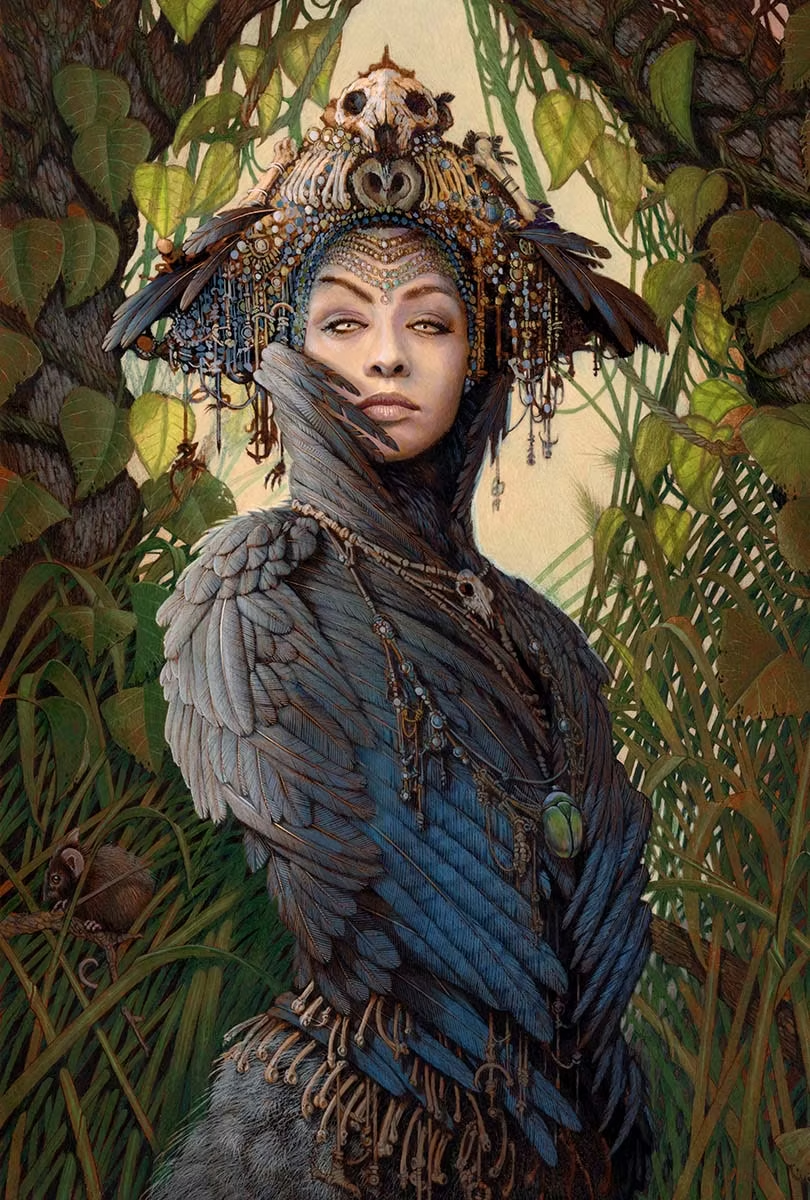
Corvid Priestess, Ed Binkley (as seen featured in the pages of The Art of Fantasy)
Have you ever had that feeling that someone is watching you from just beyond the tree line? That prickling sensation on the back of your neck while wandering a misty forest path? Perhaps it was Ed Binkley, sketchbook in hand, documenting your encounter with his meticulously detailed woodland denizens before you even realized they were there.
Binkley’s art feels less created and more… discovered, as if he’s somehow gained access to a hidden archive of supernatural field notes. His faeries, shamans, and assorted cryptid curiosities peer from the pages with such specificity that one suspects he must keep have recruited them as sources and informants, feeding him scraps of imagination and starlight so that he may best capture their likenesses in exquisite detail. There’s a sense of authenticity to these beings—they seem to exist with complete lives beyond the boundaries of the page, carrying personalities, histories, and perhaps even opinions about which mushrooms make the best rooftops.
“Corvid Priestess” peers from the pages of my book, The Art of Fantasy: A Visual Sourcebook Of All That Is Unrealwith a gaze that suggests ancient knowledge and ritual importance. Her avian elements aren’t fancy accessories selected on a whim—they’re integral to her identity as a being who bridges worlds. The remarkable fusion of human and bird creates something wholly original, a priestess whose connection to corvid energy manifests through both spirit and form. One imagines her presiding over moonlit ceremonies, communicating in languages both human and avian, serving as translator between realms.
Soul Whisperer, Ed Binkley
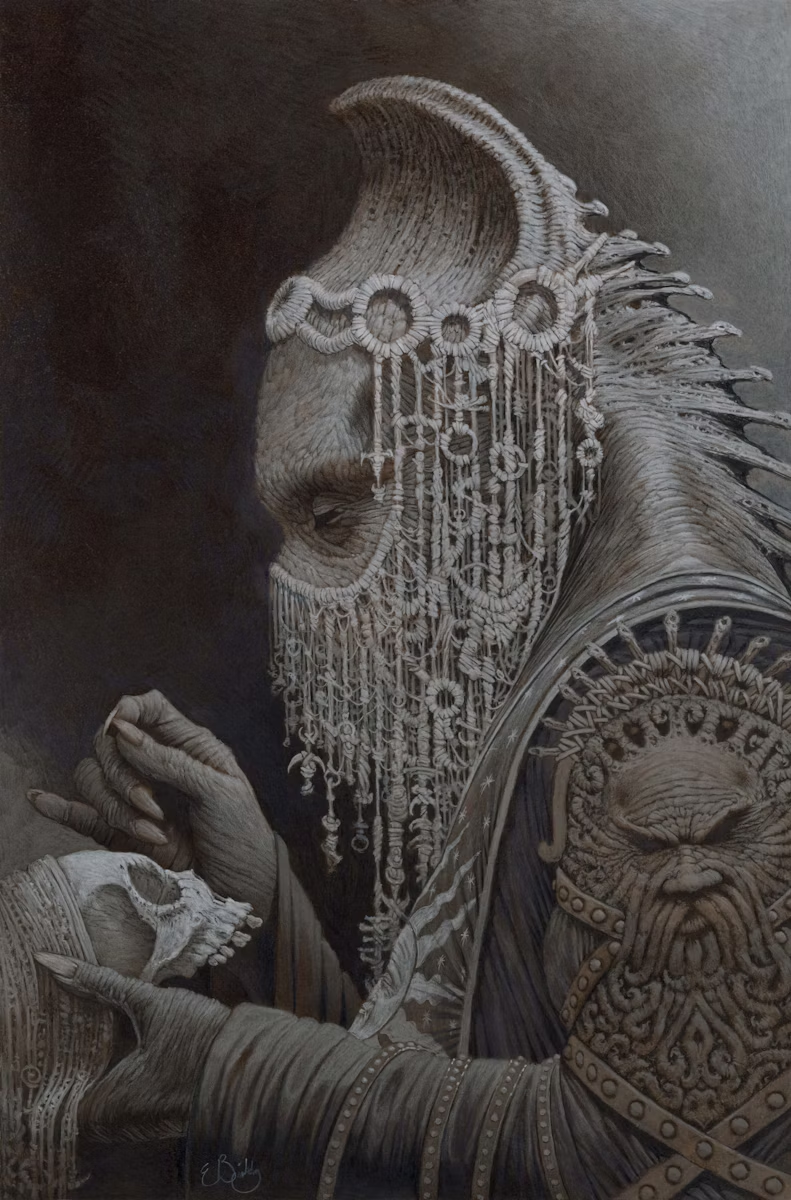
Binkley’s worlds exist next door to our own, like that neighbor’s house you’re pretty sure hosts something freaky every full moon but can never quite catch in the act. In “Soul Whisperer,” a veiled figure guides spirits to their next existence with all the calm efficiency of a supernatural TSA agent. Their veil—adorned with beads and tiny bones—makes music “like tiny wind chimes, inaudible to the rest of us,” which is just as well because the last thing you want when crossing to the afterlife is a jangly soundtrack announcing your arrival.
The textures in Binkley’s work invite closer inspection and are so tactile you’ll find yourself absently trying to pet your computer screen. Every feather, strand of moss-like beard, and antler-etched rune is rendered with precision that transforms flat images into seemingly tangible beings. His technique marries digital sketching with traditional colored pencil in a harmonious artistic union that preserves the warmth of handcrafted art while embracing technological possibilities. The result feels both ancient and immediate—beings documented in their natural habitat rather than merely imagined.
Scout, Ed Binkley
“Scout” embodies youthful vigilance and has all the hallmarks of that kid in the neighborhood who somehow always knows everybody’s business before they do. This watchful entity seems caught mid-reconnaissance, probably reporting back to some elder woodland power about the shitty humans who keep leaving energy bar wrappers in the sacred grove. The slight head tilt practically broadcasts, “I saw what you did last summer solstice.”
Binkley’s figures inhabit a rich tapestry of folklore and fantasy literature, from high-fantasy to horror to dreamscapes. These beings explore varied emotional territories while maintaining the distinctive thread that connects all his creations—a sense that these beings belong to coherent, complex societies with their own rules, rituals, and relationships.
Mantis, Ed Binkley
In “Mantis,” we meet another hybrid being, one who has embraced the full mantis lifestyle. Its elongated limbs and complex garments suggest a society with fashion magazines, designer labels, and possibly a “What Not to Wear (When Decapitating And Eating Your Mate”) reality show. The figure has perfected that quintessential mantis vibe, that stillness unique to mantids—an unnerving quality of absolute presence that makes you wonder if you’re being sized up as prey or simply observed with alien curiosity.
Ed Binkley, Chrysalis
“Chrysalis” showcases our fascination with transformation, and who among us hasn’t experienced an awkward transitional phase where we’re neither fully one thing nor another? (Minus the literal exoskeleton and carapace detritus, presumably.)
The figure exists in that universal state of becoming that feels simultaneously exciting and mortifying, the human equivalent of butterfly soup, that vulnerable yet wildly potential state where you’ve committed to shedding your old self but haven’t quite figured out what your wings look like. Like three chapters into writing a book with no clear ending in sight, and you haven’t fully worked out exactly what it is you’re writing about yet or how any of it relates to anything else at all, and actually, I don’t even know if that example relates to this artwork in the slightest, but that’s where I am at mentally right now!
Ed Binkley, Listener
“Listener” depicts a being tuned to incomprehensible eldritch frequencies. The meditative pose suggests active reception of cosmic broadcasts—picking up everything from tree gossip to star conversations to the subtextual grumblings of tectonic plates. Would such sensitivity be a gift or a curse? Would the constant chatter of atoms and echoes of ancient sounds drive one to madness? Or would it connect one to the universe in deliriously strange and wonderful ways?
Ed Binkley, Long-Tailed House-Imp, with Embroidered Suit
I’ve developed a particular affection for Binkley’s goblins—those delightful domestic prankers who, I’m convinced, live in my own home. What else explains the earring that vanished from my bathroom counter, only to materialize six months later inside the House of Psychotic Women tote bag I hadn’t used since last winter? Or the specific creak my hallway floorboard makes at 3:17 AM with metronomic consistency?
Just last week, I set my coffee mug down while checking email, only to find it had migrated to the top of my bookshelf when I turned back around. The mug, notably, had a Terry Pratchett quote about magic on it—clearly my resident goblin has a flair for the ironic. Binkley’s illustrations give these mischief-makers faces and forms, validating my suspicions that I share my living space with creatures whose entertainment comes at the expense of my sanity and organizational systems.
That’s okay, goblins; I love your crazy ways!
Ed Binkley, Moon Prayer
In our world of increasingly mass-produced, algorithm-approved visual pablum, Ed Binkley’s intricately artful fantasies feel like stumbling upon a secret garden where the plants talk back and have opinions, the bugs have human faces and agendas, and there are secret societies teeming beneath your feet, just below the range of hearing, and beyond the range of sight… but surrounding us constantly.
His creatures and beings communicate the stance of those who have traveled far, possibly through dangerous terrain, to seek admission to mysteries beyond our perception. The gravitas in their bearing suggests responsibilities beyond mortal comprehension—perhaps they maintain boundaries between dimensions or ensure that certain ancient entities remain slumbering. And yet their fusion of hybrid features with expressive humanity suggests perceptions which, though must differ wildly from our own, lurks a consciousness with recognizable emotions and thoughts that experience the universal mixture of awe and terror, hope and uncertainty, the willingness to be transformed by what comes next, that comes from merely being alive, from existing.
Each Binkley piece carries that uncanny feeling of recognition – not because you’ve met these specific beings before but because some ancient part of your brain has always known they’re out there, watching, waiting, and occasionally borrowing your good stork-handled stitch-snipping scissors without asking. His art whispers: the world is weirder, wilder, and more wonderful than they (you know, THEY) would ever have you believe.
Who are you going to believe? Them? Or Ed Binkley? I believe you, Ed.
Ed Binkley, Evening Ascending
Ed Binkley, The Firefly’s Advice
Ed Binkley, Changeling-Favorite Things
Ed Binkley, The Snail’s Story
Ed Binkley, Firefly Queen
If you enjoy posts like these or if you have ever enjoyed or been inspired by something I have written, and you would like to support this blog, consider buying the author a coffee?